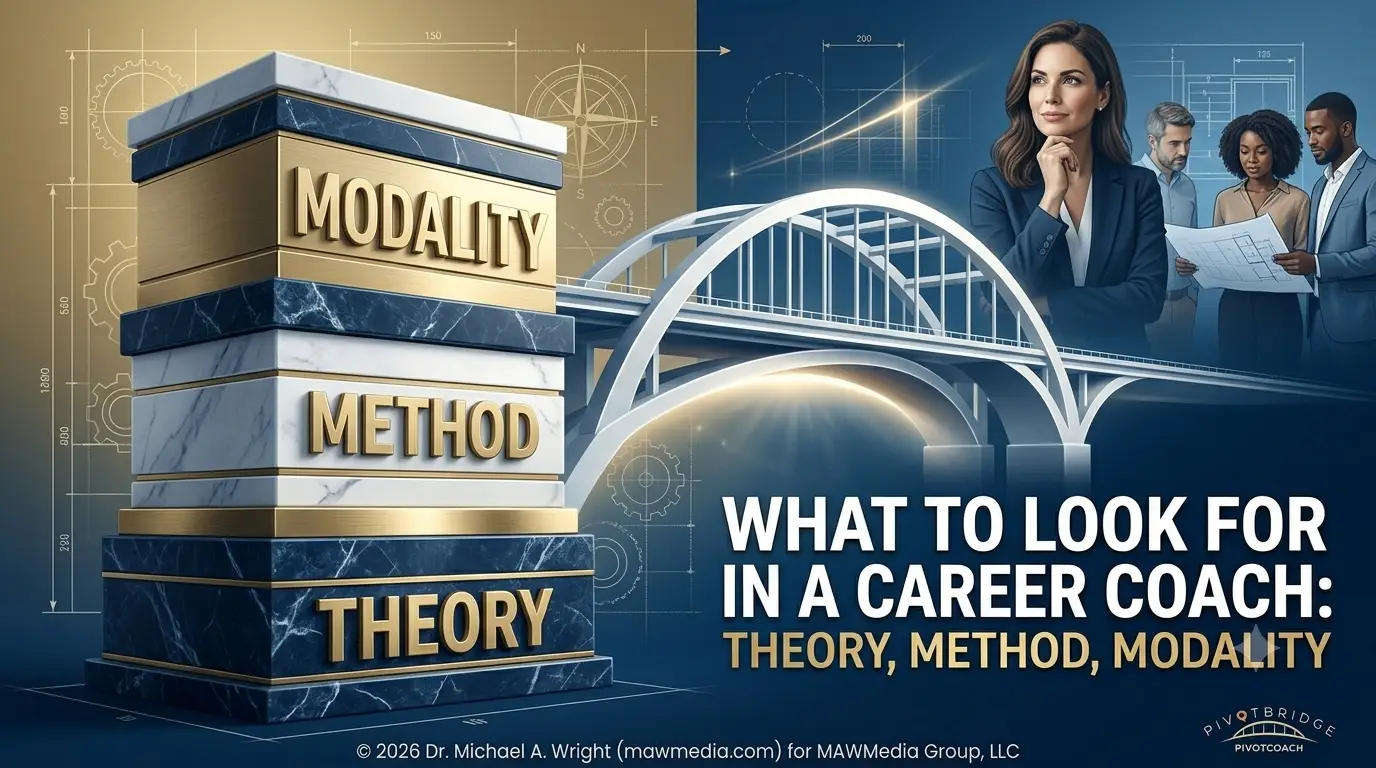
What to Look for in a Career Coach: Theory, Method, Modality
If you’re hiring for more than a pep talk, use this checklist
Most people hire a career coach when they’re stuck. Golden handcuffs. Bad job. No plan. And most people get what they pay for: resume tweaks, LinkedIn tips, and “you’ve got this!”
If that’s all you need, hire cheap. But if you’re done with forced choices and you want freedom — freedom to decide, choose, and enjoy — then you’re not hiring a coach. You’re hiring an architect of choice.
Here are the basic 3 you need. Anything less is just expensive advice.
1. THEORY: Do They Know Why You’re Stuck?
Bad sign: “Mindset is everything.” “Just believe.” “Manifest it.”
Good sign: They can explain why knowing better ≠ doing better.
What to ask: “What theory do you use to explain why informed people make unsustainable choices?”
What you want to hear: Something grounded in systems, not slogans.
thePivotCOACH example: We use Complex Adaptive Systems [CAS]. Your career isn’t broken because you lack willpower. It’s emergent. It’s the result of identity loops, socialization, intersectionality, trauma, and environmental feedback. You’re not a problem. You’re a system.
Why it matters: If they can’t name the system keeping you stuck, they can’t help you redesign it. They’ll just blame you when the pep talk wears off.
Practical test: Ask them to explain your current situation using their theory in 60 seconds. If they can’t, walk.
2. METHOD: Do They Have a Repeatable Way to Build Your Bridge?
Bad sign: “Every client is different, so I just intuit it.” “We’ll see where the conversation goes.”
Good sign: They have named steps. A framework. A branded intervention.
What to ask: “Walk me through your method. What happens in week 1, week 2, week 6?”
What you want to hear: Structure. Sequence. Deliverables.
thePivotCOACH example: We use the COACH Method — an 8-step ecological intervention.
- GamePlanning — Authentic goals + Product Pyramid. Week 1.
- Meditative Regimen — Regulate anxiety so you can learn, not panic-do.
- Budgeting — Time + money allocation.
- Reciprocity Assessment — Map your team. Activate with scripts.
- Coaching Implementation — Training + modeling new behaviors.
- Progress Evaluation — Metrics. Not feelings.
- Invitation into Community — Idea → hard work → smart work → team work.
- Continuing Education — Leadership + wealth pathway.
Why it matters: Freestyling is fine for therapy. For change, you need architecture. The PIVOT is the bridge. You should know where you’re stepping next.
Practical test: Ask for a 1-pager of their method. If they don’t have one, they don’t have a method.
3. MODALITY: Do They Assess You or Just Advise You?
Bad sign: “Tell me your goals” is the whole intake. No assessment. No diagnostics.
Good sign: They use a clinical-grade tool to model how you make choices before they tell you what to do.
What to ask: “What assessment modality do you use? How do you measure my Perception of Self in Environment Reality?”
What you want to hear: Something operational. Something predictive.
thePivotCOACH example: We use POSE-R: Perception of Self in Environment Reality.
It’s an advancement of the Biopsychosocial-Spiritual model using agent-based modeling + control system theory.
Translation: We don’t just listen to your story. We model your choice architecture. We trace why you dismiss Option B. We identify if your “undeserving” identity is limiting your choice set. Then we install a new one: identity that wins.
Why it matters: Advice without assessment is malpractice. You wouldn’t take meds without a diagnosis. Don’t take career direction without a choice diagnostic.
Practical test: Ask, “What will your assessment tell me that I don’t already know about myself?” If the answer is “your strengths,” hang up.
The Practical Checklist: Hire/Don’t Hire
| If they say… | You should… |
|---|---|
| “My theory is positive psychology” | Don’t hire — That’s a framework, not a theory of why you’re stuck |
| “My method is customized to you” | Don’t hire — No method = no bridge. You’re paying for improv |
| “My assessment is a values worksheet” | Don’t hire — That’s self-report, not diagnostics |
| “I use CAS theory + COACH Method + POSE-R” | Interview them — They at least speak architecture |
| “Here’s the bridge. Step 1 is GamePlanning.” | Hire — They know freedom is the outcome, not the input |
Bottom Line
Career coaching isn’t worth the money.
Architecting a new system of choice is. But only if your coach brings:
- Theory — Can explain your system
- Method — Can build your bridge
- Modality — Can diagnose your choice architecture
Most people just want a job. If that’s you, use AI. It’s free.
If you want freedom to decide from solid options, freedom to choose without limits, and freedom to enjoy without constraints…
Stop hiring coaches. Start hiring architects.
Here’s the bridge to freedom.
Dr. Michael A. Wright, PhD, LAPSW
thePivotCOACH | Pivot Bridge™
POSE-R Assessment • COACH Method • Complex Adaptive Systems