From a Job to an Impact: Mastering Metacognition, Platform, and Agency
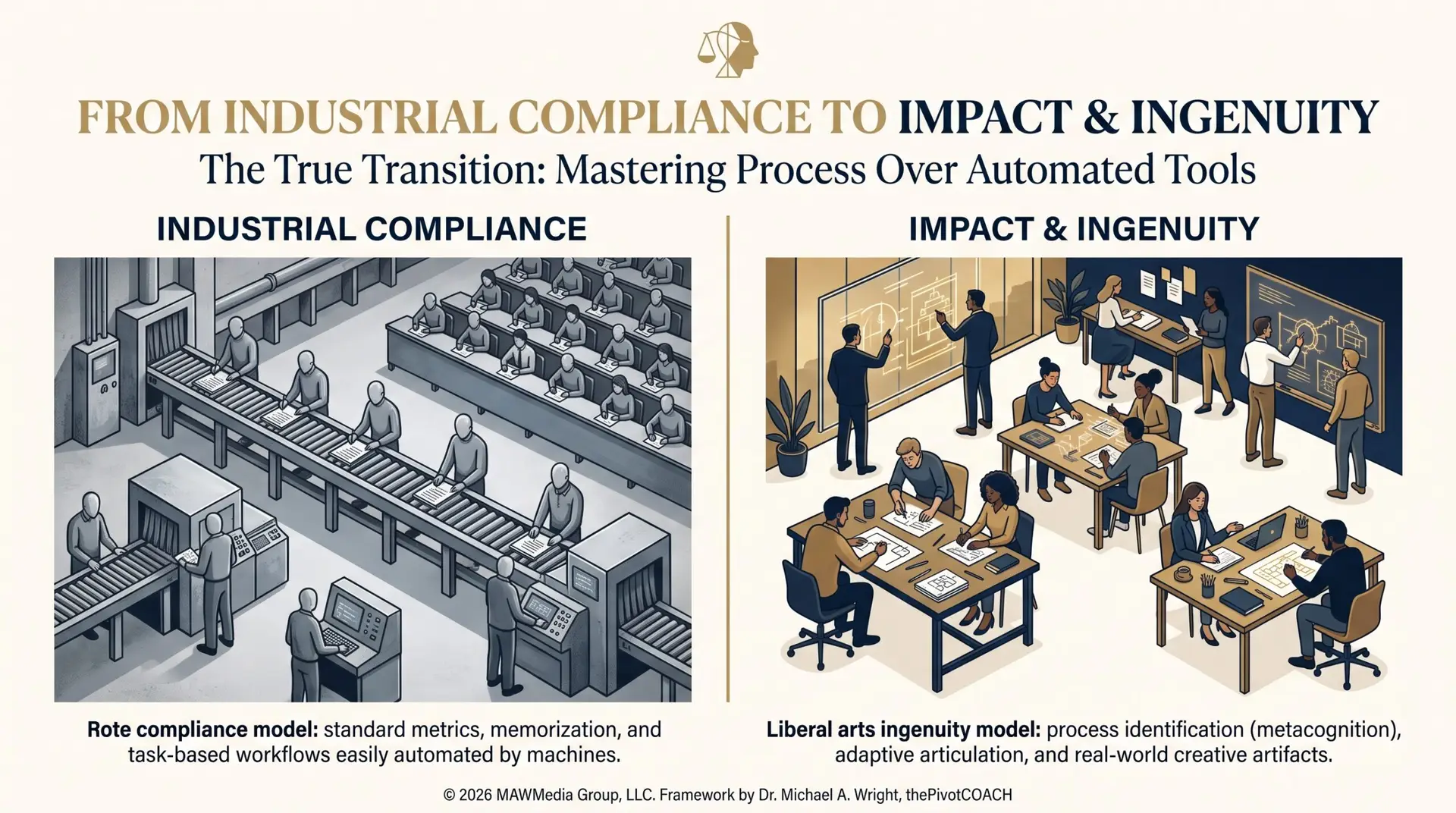
For over a century, the default promise of economic and educational systems has revolved around a single, transactional container: get a job.
Rooted in the industrial philosophies of Andrew Carnegie and Henry Ford, this legacy model was engineered around Taylorist efficiency. Its goal was straightforward: prepare individuals for procedural compliance, train them to operate under the rule of an institution, and measure their capability by how reliably they fit into standardized, pre-cut organizational boxes.
Before 1993, this model served a predictable economic purpose. But the democratization of the internet irrevocably flattened access to the tools of production, distribution, and global collaboration. As we move deeper into what I describe as the Age of Managed Creativity—a landscape accelerated by artificial intelligence—the old equation has expired.
The critical reframe is no longer from “job to work,” but from “opportunity to impact.”
A job is simply a static, linear task sequence—a workflow that software and algorithmic tools can automate with increasing ease. Impact, by contrast, is systemic contribution: building and delivering outcomes that actually feed, solve, and transform the world.
Shifting from seeking an external job to generating sovereign impact requires a three-part operating architecture: Metacognition, Platform, and Agency.
Metacognition: The Internal Command Center
At its foundation, metacognition is the capacity to think about your own thinking. It is the deliberate, reflective mapping of your cognitive processes, biases, problem-framing habits, and internal recipes.
In an automated environment, simply executing a linear sequence—Step 1 to Step 2 to Step 3—provides no defensive moat. If your skill set consists only of following an instruction manual, an algorithmic prompt can replace you in seconds. Metacognition is the skill that separates what you do from how and why you do it.
Consider software engineering or data analysis. An engineer without metacognition prompts an AI tool, copies the generated syntax without inspection, and hopes it runs. When the system hallucinates or breaks at scale, they are helpless because they never understood the underlying architecture.
By contrast, a metacognitively disciplined practitioner treats generative tools as an interactive sounding board. They explicitly map why they framed the problem in a specific architecture, anticipate edge cases, cross-examine machine suggestions, and course-correct anomalies in real time. Metacognition is the deliberate practice that transforms raw procedural work into proprietary insight.
Platform: The Sociotechnical Vehicle
If metacognition is your internal process, your platform is the vehicle through which your contribution reaches, interacts with, and impacts the world.
Historically, accessing a platform meant convincing a corporate gatekeeper, an academic tenure board, or a publishing cartel to grant you distribution. Today, platforms are decentralized and multi-dimensional:
- Digital Infrastructure for Wares: Platforms like Shopify, Substack, or open-source software repositories provide individuals with instant, direct-to-consumer pipelines. A creator no longer needs a multinational distribution arm to market physical wares, software plugins, or bespoke advisory services to an international audience.
- Your Current Employment as an Incubation Platform: Crucially, your traditional job can itself be reframed as an operational platform.
Rather than viewing an employer as the permanent custodian of your economic identity, view your role as an active laboratory. A job is a platform where you are compensated to solve real-world problems, observe organizational friction points, engage in deliberate practice, and refine your unique intellectual property (IP).
Every complex challenge you resolve inside an organization is market-tested research. When approached with clarity, your daily work becomes the testing ground for developing your proprietary frameworks, methodologies, and operational models—assets you can eventually license, publish, or deploy independently as sovereign IP.
Agency: Intentional, Purposeful Action
Neither metacognitive awareness nor a robust platform produces impact without agency.
Agency is intentional, informed, and purposeful action directed toward a coherent vision. It is the opposite of passive compliance, cognitive insulation, and algorithmic autopilot.
Agency means refusing to outsource your core judgment to convenience or bureaucratic momentum. It requires setting explicit ethical parameters, selecting the specific problems you intend to solve, and driving through the inevitable friction of building something original. Where an employee waits for instructions, an agent identifies an opportunity, marshals available platforms, and builds an undeniable, real-world build that speaks for itself.
Beyond the Factory Floor
We have moved beyond the historical era where personal security could be found by hiding behind an institutional compliance mask. The tools of our era do not care about bureaucratic obedience.
You may maintain an active job today—and if that job supports your metacognition, finances your experimentation, and offers a platform to sharpen your skills, it is serving a vital strategic purpose. But the ultimate target is never the job itself. The target is what you build, what you refine, and the lasting contribution you make.
When you cultivate rigorous metacognition, leverage every accessible platform, and act with unwavering agency, your contribution ceases to be a speculative resume claim. It becomes an undeniable, real-world impact that feeds the world.